
In Early School Days
Maggie Halsell, Spokane County School Superintendent, June 1892

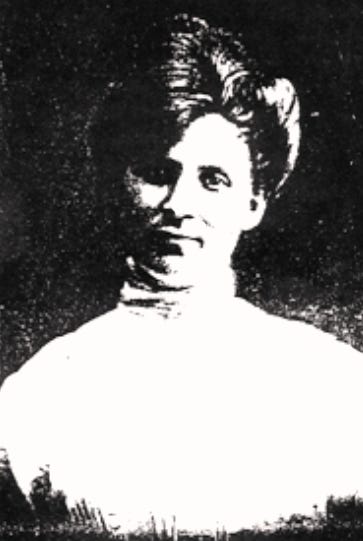
Below is the text of a paper read before the 1892 Teachers’ Association by Spokane County School Superintendent Mrs. Maggie Halsell, elected in 1879, telling of the experience as a school superintendent traveling the frontier to oversee the many schools in the county.
/!\ Contains uncensored language that is considered outdated and insensitive.
It was in the days of ‘79 in Eastern Washington when the southern half of Stevens County was organized into what is now Spokane County, and stretching far to the west and southwest over the vast prairies of the Big Bend to the Okanogan including what is now both Lincoln and Douglas counties. Spokane County, at that time, was about three times its present size. This frontier, then unlike the present, was sparsely settled with civilization; the broad prairies abounded in wild animals and savages. There were few roads, no towns, cities, or railroads, and only two or three small villages within the limits of Spokane County. Rockford and Spangle (the latter known as Pine Grove) contained a store, a schoolhouse, and a few dwellings. Spokane Falls, without streets or much improvement as seen in ‘78, located upon the banks of the picturesque falls and river after which it was named contained only a few board shanties and log cabins occupied by settlers and soldiers; Cannon and Warner’s store; the post office, kept by Sylvester Heath; Percival’s blacksmith shop, a saloon, and the uncompleted buildings of Post’s flouring mill and dwelling-house dotting the rocky hillside and the precipitous banks.
The few frontier settlers, feeling the need of school privileges, decided their own resource was to build a schoolhouse and hire a teacher. with J.J. Browne, A.M. Cannon, and George Davis in the lead, the little village of Spokane was successful in raising enough money and labor to build a schoolhouse and pay a teacher for the short session of two months. Captain Tobias was the first school teacher, giving good satisfaction. He prevailed upon them to continue the school a month longer; they, in their opposed and burdened efforts, finally succeeded in making up the sum required and granted his requests.
The greater part of the people felt it such a trial to leave civilization, with all the benefits and luxuries of an old settled country, and come to this wilderness to be taxed beyond measure in order to build up a school, when many of them wintered in open houses with only blankets for shutters to keep out the cold.
Many were the times that the war songs were heard at dead of night, bringing the thought of horror and despair to the unprotected pioneers.
Realizing the awful moment, the settlers set about for safety, some going south to Walla Walla others procuring rifles from the government, desiring to protect themselves. With this and many other disadvantages commenced the discourage people of Spokane County. Some believed that the fates were against them and felt they could not succeed if they would; others thought “it is the outcome of our own chosen course realizing that which will affect us in gaining coveted results is not wholly our condition but the spirit in which we meet it”. The feet which tread the Indian Trail may someday walk in presidential halls and the child of a frontiersman may become an eminent statesman. at this time (if I mistake not) there were only five school districts, viz. No. 8 Spokane Falls; No. 9 White Bluff Prairie; No. 7 Spangle; No. 3 Rockford; No. 5 Wimpy district, near Idaho line; but during the year 1880 were 33 organized. These at first used the old Stevens County numbers, but all have since been renumbered. We were where we had a vision of the conflict before us. One can hardly realize the amount of courage required to face and encounter the dangers of the Indian trails, while attending to official business in these various districts, such as visiting schools, aiding in a satisfactory location of school houses and determining the necessary divisions and organizations of said districts, all of which required much time in writing. No doubt the present county superintendent’s office is unsupplied with a satisfactory school record of Spokane County for 1880, but being unfurnished with necessary books and office I decided most of my work was in the field. Filled with vigor and enthusiasm when accepting the county school superintendency, I did not realize (although dismayed by parental opposition) the dangers abroad to be any greater than those at home. being surrounded by painted Indians, armed with bows and arrows, singing their war songs, was a living horror to be endured by the pioneers.
Spokane County’s first surveyor, while on duty in the Coulee country, was severely wounded and left for dead by the Indians, who mounted his horse and disappeared in the woods. The same day on my return from visiting a school, when within four miles of home I was startled by two drunken Indians, one whom clutched the bridle reign of my horse which taking fright, reared frantically, loosening the hold of the fiendish captor. no time was lost in making good my escape. With fear and caution many miles were traveled across the broad prairies and belts of timber, only to find myself at the door of a little log cabin called a schoolhouse in which the teacher had from four to twelve urchins seated on hewed slabs, which were laid upon sawed cuts of logs.
With little or no furniture, scarcely books enough, and these of various series, yet both the teacher and the child strove to make school work a success. On one occasion, while visiting a school, I was surprised to find two “teachers” partly employed in teaching 7 children. on entering the old log cabin I decided that the teachers (an elderly man and his wife) also boarded and lodged in the same department in which they taught. Although it was small they seemed to find room for all, seating them on trunks, boxes, and their bed. Nothing had the appearance of order. The children were accustomed to talking aloud and it did not seem any part of their program to devote their time to study. One of the recitations was conducted after this manner:
Teacher - “ What do you think, Nellie, about this lesson in addition?”
“Well, I don’t know much about it, I’m sure,” replied Nellie.
Teacher - “Harry, have you thought anything about it?”
“No-o-o,” responded Harry.
The teacher, after his usual custom, with slate in pencil in hand, made a faint effort to show one or two in the class how to “add sums,” as he said. Realizing it was only a play school, I thought to make it more profitable by obtaining a handful of pebbles from the dooryard and readily teaching the children to add and subtract.
As the time was nearing noon, the poor, weary, careworn teachers thought to make ready their dinner. the school ma’am said (introducing the subject): “George, if you will get some wood and Annie make a fire, professor will bring a pail of water, while I tell my other class something about division.” Fearing I would be asked to give one of the girls or the “professor” a lesson in making biscuits, I prepared to leave. On starting I asked the “professor” if he or his wife had a certificate he replied, “Why no! I didn’t suppose a little school like this that we needed any surtificut. The deestric hired me and my wife for $50 a month, and we are going to teach three months.” By the intercession of the district school board, the “professor” received a “permit”, but at the next semiannual examination neither he nor his wife returned the second day to hear their standings.
On another occasion while attempting to visit a school at Rockford, I found (going by the way of Spangle) that Hangman crossing was reported dangerous. There being no bridge I was obliged to cross on the ice. After traveling nearly all day over ice and snow clad trails, through the timber and over the hills, part of the time through sleet and storm, I was discouraged, fearing an unsuccessful trip. But on arriving at the bank I concluded to make my tie rope fast to one end of the bridle rein and leave my horse on the shore while I tried the ice crossing first and alone believing if I fell through by means of this rope and rein attached to my horse I could get out. The ice was stronger than reported although it was cracked into or more places. Arriving safely on the other side I urged my pony to follow by pulling upon the rope. He, apparently distrusting my judgment of the ice, repeatedly persisted in not coming until some boys who were playing nearby persuaded him by the use of willow whips. Fearing he would go through the ice I pulled and tugged at the rope the while he was crossing, realizing that the ice was shaking under his feet. Soon, however, the nimble little creature was at my side seemingly expecting praise for his bravery and success. In a few short hours I reached the house of one of the school directors, Commissioner Roberts, by whom I was treated with much hospitality. next morning I visited the school, which was taught by a man with untiring energies and good qualifications. His school was in a prosperous condition, despite the ill furnished schoolroom. On my way home that afternoon, coming down on this side of Hangman Creek, I stopped at a cabin to stay all night. The lady whose husband had gone to Colfax, was so alarmed by the Indians that she had the windows nailed and curtained and every door locked. I being a welcome visitor, enjoyed a restful night, regardless of the disturbances by the Indian yells.
Published in the June 12, 1892 issue of the Spokesman-Review.